Although there is a fair choice of GUI libraries for Python (good overview of Python GUI libraries is here), sometimes we need just a little bit more enhanced terminal interface, like in my recent project - XMPP test client - where requirements were quite simple - just to split terminal screen into two areas - main screen where messages are displayed (possibly asynchronously) and bottom line, where commands/messages can be entered:
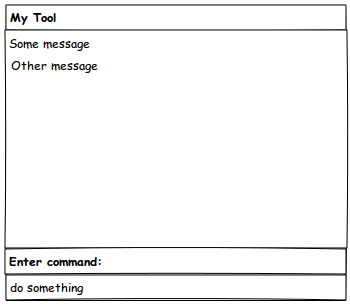
In Python we have couple of options for terminal UI programming:
- curses - curses library is part of standard python distribution, it provides lower level access to terminal programming and terminal control sequences. Many things are left to users - like resizing UI, event loops etc.
- urwid - is an excellent external library, which provides higher level interfaces for programming terminal UIs. It's a bit similar to above mentioned GUI kits, providing widgets, layout managers, event loop etc. And many common tasks missing in curses are already included.
I decided to use urwid, because it looked easier to start with and many required functionalities were already provided (like already mentioned resizing, which I think would be pretty tedious to re-implement in curses). I've created simple commander module, which provides interface similar to build-in cmd.Cmd, but with UI layout as shown above. With this module we can create simple tools very easily:
if __name__=='__main__':
    class TestCmd(Command):
        def do_echo(self, *args):
            '''echo - Just echos all arguments'''
            return ' '.join(args)
        def do_raise(self, *args):
            raise Exception('Some Error')

    c=Commander('Test', cmd_cb=TestCmd())

    #Test asynch output -  e.g. comming from different thread
    import time
    def run():
        while True:
            time.sleep(1)
            c.output('Tick', 'green')
    t=Thread(target=run)
    t.daemon=True
    t.start()

    #start main loop
    c.loop()
Which creates tool like this:
